


In jewellery, when we talk about 'precious stones' we are referring to those gems that stand out from the rest due to their shortage y durabilityin addition to its attractive And what specific criteria do we use to differentiate between stones that are so peculiar and distinctive? beautiful (natural) and semi-precious (synthetic)?
- The hardnessThis is closely linked to its excellent durability over the years. The hardest and most resistant gemstone on the planet is the diamond.
- Your uniqueness o difficulty to find it in nature. A scarce mineral will always be much more expensive.
- Your beauty y perfection in terms of colour, lustre, transparency and purity.
Among the precious stones of, say, first orderThe main ones stand out: ruby y sapphire (corundum), emerald (beryl) and the great ruler who watches them from the top of the pyramid, the diamond.
Let's look at them, one by one:
- THE DIAMOND: from Greek, adamasmeans 'the unbreakable'. Its carving hardness is 140 times greater than that of ruby or sapphire, the next in the 'line of succession'.
They originated at great depths (150-300 km or more), at very high temperatures and pressures. Because of their characteristic lustre, high hardness and rarity, diamonds are considered to be the King of all precious stones.
If you are interested and want to know more about the characteristics of diamonds, we share with you several articles where we explore more in depth all the particularities of this gemstone: "The more carats, the better the ring?" y "What is the GIA certificate?

- THE RUBY: Its name comes from the Latin, 'rubensand was recognised within the corundum group around 1800. In jewellery we use two varieties of corundum colour: red (ruby) and blue (sapphire); the two minerals harder after diamond.
The colour distribution is often patchy, banded or blotchy and the colouring substance is chromium. Inclusions are quite frequent - which does not detract from the quality - and give us clues about the deposit. The most sought-after colour of ruby is known as "pigeon's blood", a pure red with a bluish hue.
It is associated with protection, harmony, prosperity and love.
- THE SAPPHIRE: belonging to the corundum group like ruby, very similar in terms of hardness. Its name comes from the Greek, "blue"They are also available in yellow, green, light red, pink, violet and even colourless (leuco-sapphire). The most prized is the cornflower blue sapphire.
The 'Prosperity Stone' is often used in meditation practice, as it brings peace of mind and helps to have better intuition and awareness.

- THE EMERALD: from the Greek "smaragdos", means "green stone". It belongs to the beryl group and, unlike diamond, has a certain brittleness which, together with frequent stress cracks, makes it particularly sensitive to pressure.
The most prized emeralds are those with few inclusions - or as we know in jewellery, "little garden" - and their intense green colour is explained by the presence of chromium in their composition. It is considered the gemstone linked to nature, magic and fantasy. It is also associated with peace and tranquillity and is often used as an amulet to attract good energies.
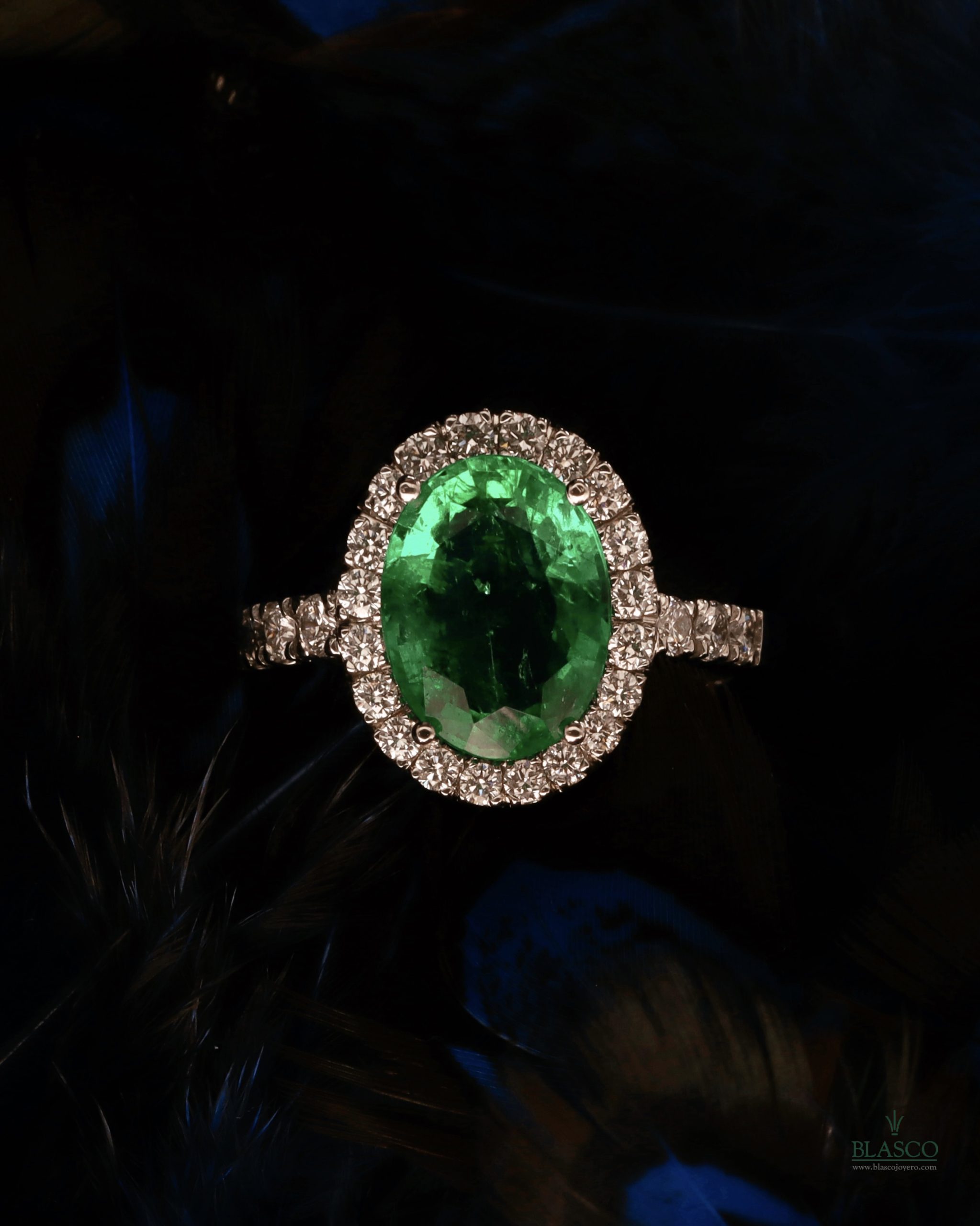
In Blasco Jeweller we have an extensive catalogue with a wide variety of unique, handcrafted pieces and beautiful combinations with each of these gems. Take a look at our website or come and visit us at our shop in C/Barítono Marcos Redondo, 3 (Murcia), we will be delighted to welcome you and advise you on everything you need!
